

Loading data...

Luminescence is a collective term for the property of minerals to emit light under certain conditions. Despite different triggers, the fundamental mechanism of its formation is always the same and is based on the excitation of electrons in the atomic structure.
When certain minerals are illuminated with high-energy ultraviolet light (UV-A at 365 nm or UV-C at 254 nm), electrons are excited from their ground state to a higher, more excited state. In this excited state, however, they are unstable and first fall to an intermediate energy level. In doing so, they release vibrational energy (phonons) as heat to the atomic lattice. Even in this intermediate state, the electrons are unstable and eventually fall back to their ground state. Since the electrons have already lost energy as heat in the first step, the remaining energy gap is smaller than the original excitation energy. Because the energy of a photon is equal to its wavelength, lower-energy, longer-wavelength, and therefore visible light is emitted (Stokes shift). This emitted light is thus visible to us as fluorescence . The wavelength and therefore the color of this emitted light depends on (1) the type of activator ion, (2) the geometry of the crystal lattice and (3) the bond strength in the crystal lattice.
For example, manganese ( Mn²⁺ ) ions in the lattice of willemite can lead to green fluorescence, while in calcite they are responsible for red fluorescence. The reason for this lies in the arrangement of the neighboring oxygen atoms in the lattice (coordination number). In willemite, zinc (and thus also the substituent manganese) is surrounded by four oxygen atoms in the form of a tetrahedron. A tetrahedron leaves relatively ample space for the manganese electrons. The repulsion between the oxygen electrons and the manganese electrons is comparatively weak. As a result, the energy gap that the electron has to traverse during the final quantum leap remains relatively large. The emitted light is high-energy and short-wavelength (green). In calcite, calcium (and thus also the substituent manganese) is surrounded by six oxygen atoms in the form of an octahedron. An octahedron forces the oxygen atoms much closer to the manganese ion. The negative charges of the oxygen collide massively with the electrons of the manganese. This strong electrical repulsion distorts the energy levels of the ion. A strong splitting of the crystal field occurs, which energetically lowers the stable intermediate energy level, making the remaining energy gap to the ground state minuscule. The emitted light is therefore relatively low in energy and has a long wavelength (red).
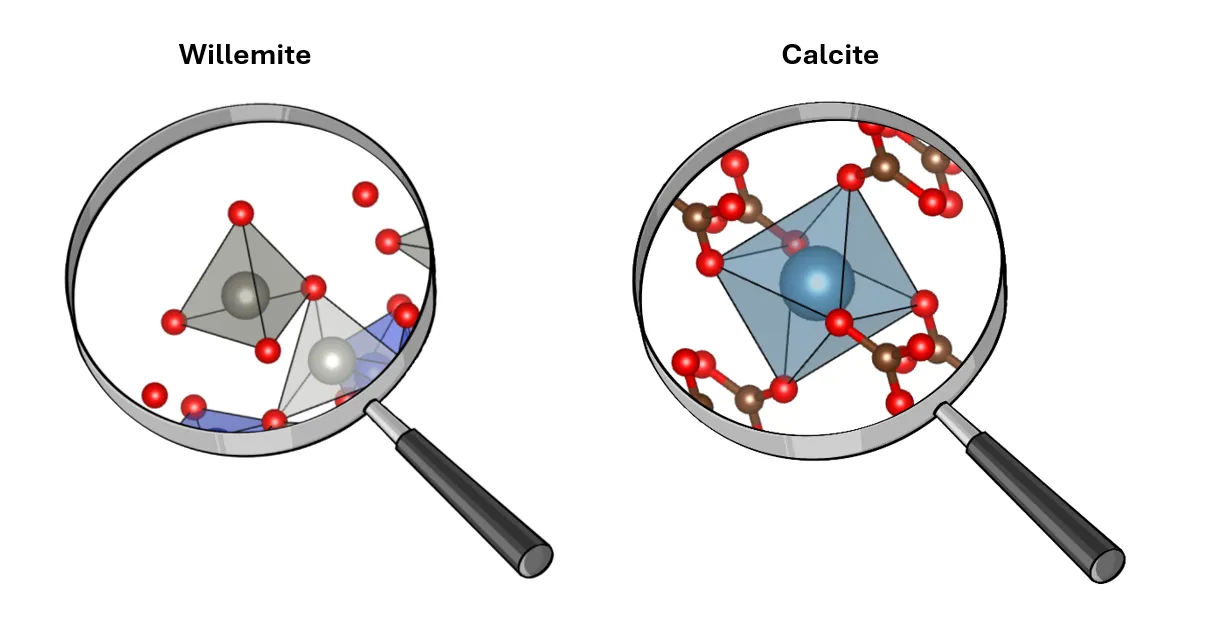
The different oxygen coordination in willemite and calcite is the main reason for their fluorescent colors.
In the mineral afghanite, the cause of the strong fluorescence (image) is not metal cations, but is initiated by the incorporation of disulfide anion radicals (S 2 - ). These occupy isolated cavities between the [SiO 4 ] 4- and [AlO 4 ] 5- tetrahedra, which are otherwise occupied by large cations (Na + , K + ) and anion complexes ([SO 4 ] 2- ).
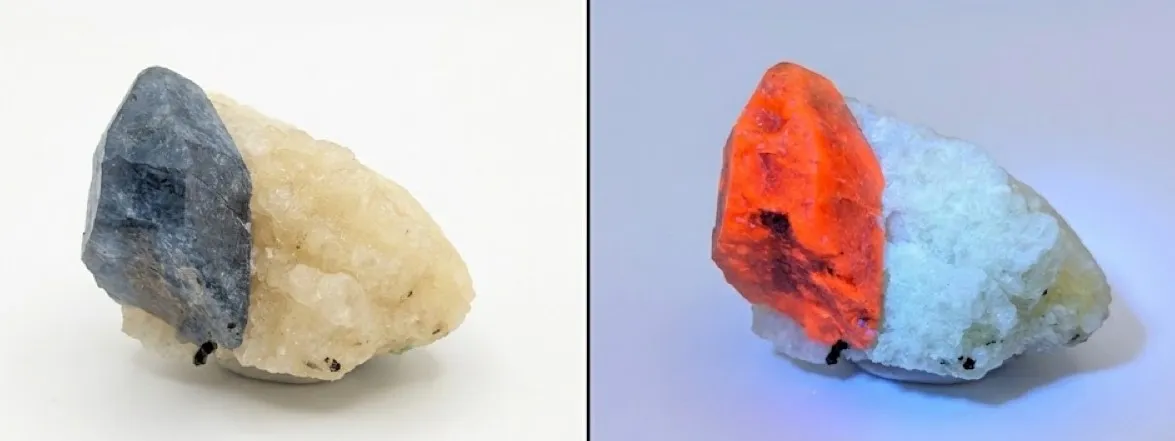
Afghanite before and after excitation with a UV light source.
Normally, the proportion of UV radiation in daylight is too weak to excite electrons in the crystal lattice sufficiently to emit a photon when they return to their ground state. An exception is so-called daylight fluorescence , which occurs, for example, in fluorites from England. The cause is the element europium ( Eu²⁺ ), which can replace Ca²⁺ in the crystal lattice. Europium has closely spaced electron shells (4f and 5d orbitals), which are further constricted by the surrounding fluorine atoms. Therefore, even the small UV component of daylight is sufficient for electrons to jump from the 4f to the 5d shell. Nevertheless, the energy gap between the shells remains relatively large, which is why the emitted light is high-energy and short-wavelength. The otherwise green fluorites thus glow with an intense blue-violet light, especially at their edges and corners.
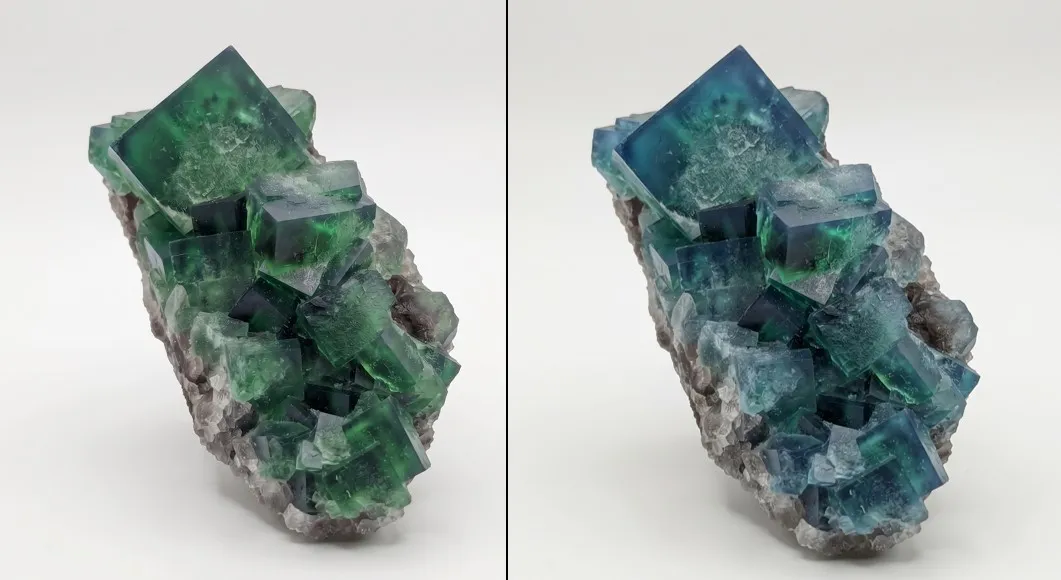
Daylight fluorescence on a green fluorite from the Diana Maria Mine, England, UK
Unlike fluorescence, phosphorescence is a time-delayed phenomenon. In this state, the excited electrons temporarily reside in a kind of forbidden quantum state and only very slowly return to their ground state. To understand this, one must know that in the ground state, each orbital always contains two electrons with opposite spins (one spins upwards, the other downwards). When UV light catapults an electron upwards, it stubbornly retains its spin direction. The system is in the so-called singlet state ( S1 ). From here, the downward fall is instantaneous (fluorescence). However, in certain minerals (favored by heavy atoms), the electron suddenly flips its spin direction at the excited level (spin flip) and thus spins in the same direction as its remaining electron partner in the ground state. This state is called the triplet state ( T1 ). Once an electron is in a triplet state, it cannot initially return to its ground state because electrons in the same orbital cannot have the same spin (Pauli exclusion principle). Only a small energy impact from the outside can cause the electron to change its spin and thus return to its ground state. This energy impact is usually caused by lattice vibrations (phonons) triggered by ambient heat. However, since these thermal collisions occur randomly within the mineral, only a tiny fraction of the trapped electrons are released each second. The result is a continuous, slow stream of emitted photons, which is why the mineral glows in the dark until the last electron has returned to its ground state.
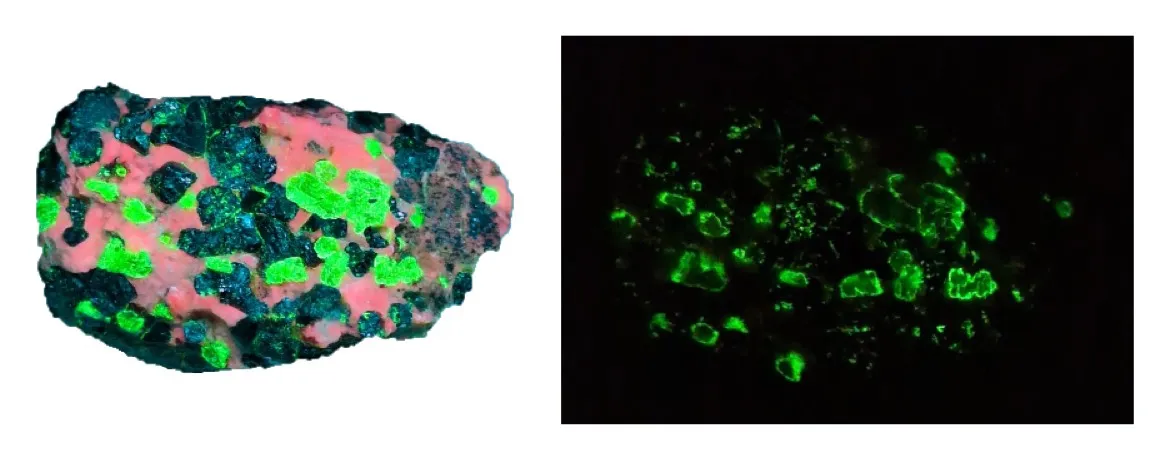
In addition to its intense green fluorescence, willemite also exhibits visible phosphorescence, as can be seen in this piece from the Franklin Mine, New Jersey, USA.
The trigger for luminescence is thermal energy (heat below the glowing threshold), which releases electrons that have been trapped in vacancies of the crystal lattice (centers) by natural radioactivity over geological periods and now fall back to the ground state by emitting light (e.g. in some calcites and fluorites).
The excitation is achieved by continuous bombardment with ionizing radiation (alpha, beta or gamma radiation) from the decay of radioactive isotopes, which permanently excites the surrounding electrons in the lattice to glow (historically used in radium dials; in nature in uranium minerals such as autunite).
Luminescence is triggered by an exothermic chemical reaction in which the reaction energy directly excites the electrons of a molecule, instead of being released as pure heat (not existent in pure mineralogy, but the basis for artificial glow sticks).
A special biological form of chemiluminescence in which the excitation occurs through an enzymatic reaction in living organisms (e.g., in fireflies or deep-sea fish) and which plays no role in mineralogy.
The trigger is a high-energy electron beam (cathode ray) in a vacuum, whose kinetic energy, upon impact with the mineral, excites a large number of electrons into excited states, resulting in an intense glow as they fall back. (This is an indispensable tool in mineralogy for visualizing growth zones in zircon or quartz.)
Emission is induced by mechanical deformation such as rubbing, striking or breaking, since the violent separation of chemical bonds at the fracture edges creates massive electrical charge differences, the lightning-like discharge of which excites electrons of the surrounding air molecules or also in the mineral (classically when sphalerite is broken).
The trigger is a continuous, elastic pressure on piezoelectric crystals, which, through the displacement of ion charges in the lattice, creates a permanent internal electric field that energetically excites electrons (e.g., in quartz).
Luminescence is triggered by the phase transition during the crystallization of a mineral from a solution or melt, whereby the released lattice energy (crystallization energy) is directly converted into the quantum mechanical excitation of electrons (observable, for example, during the rapid crystallization of sodium chloride or barium sulfate).