

Loading data...

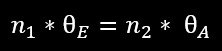
When an object (e.g., a mineral) is illuminated by a light source (e.g., the sun), some of the light is reflected at its surface and some is refracted into the mineral. The degree of refraction can be quantified by a material-dependent constant of the respective medium, the so-called refractive index (n). The higher the refractive index, the slower the speed of light propagation and the more the wavelengths are shortened as they pass through. Generally, minerals with higher density have a higher refractive index because they contain a greater number of atoms and molecules per unit volume; however, there are numerous exceptions (see, for example, Figure 1). This is primarily because the refractive index depends significantly on the polarizability of the electron shells of the atoms involved. When light travels through a mineral, the electric field causes the electron shells of the atoms to vibrate. The more easily these electron shells can be deformed (polarizability), the more the light wave is slowed down and the higher the refractive index. Titanium ( Ti⁴⁺ ), for example, has an incompletely filled d-electron shell, while tin ( Sn⁴⁺ ) has a fully occupied, stable d-shell. Therefore, despite its higher mass, cassiterite attenuates light less (lower refractive index). The relationship between the refractive indices of the two media ( n₁ , n₂ ) and the angles of incidence and refraction ( θ₉ , θ₀ ) is described by Snell's law of refraction .
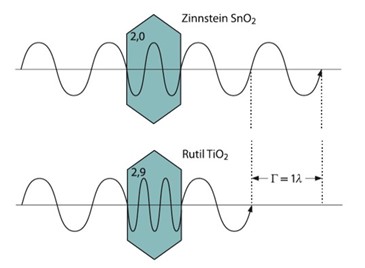
The effects of different refractive indices of the two minerals
Cassiterite ( SnO₂ ) and rutile ( TiO₂ ) refract light at specific wavelengths. Although cassiterite is the denser mineral, it has a lower refractive index.